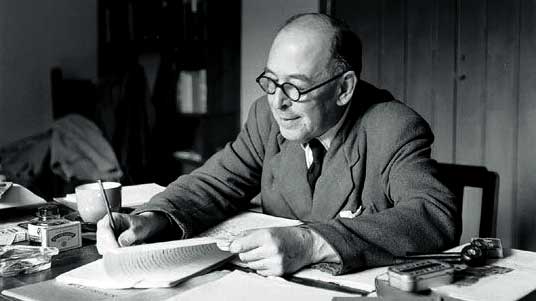
C.S Lewis wrote under the pseudonym Clive Hamilton when it came to his poems, something he wished to achieve greatness in. His death was largely unreported because it unfortunately happened on the same day as JFK was assassinated. Oh, and he only had one thumb joint.
I mention that last point because C. S. Lewis never learned to type. That was what I discovered when I was looking at the arguments for and against writing longhand in the age of technology. Some have pointed at the weird thumb goings on as the cause, but it may not be anything as physiological. Instead there is the suggestion it is something much deeper. Something that all of us, as writers, should consider.
He apparently believed that the typewriter could not capture – perhaps even interrupted – the rhythm of writing. There have been many authors since who have followed the same argument; that there is something much more deliberate about writing with a pen and paper than there is on a keyboard. Today especially, when keys are whisper soft and require only the barest of touches, it is easy to pour out the words lightening quick. You don’t even have to press hard or do that thing at the end of the line when the carriage returns with a happy little ‘ding’ sound. Apologies to any younger readers who legitimately have no idea what I’m talking about. You should try and find a good old fashioned typewriter some time.
The pen forces a slowness, a deliberateness; each word can be thought about and selected as the hand forms its predecessor. For many authors today, especially those who are self-published and feel the pressure to release multiple books a year, there is a sense that every word must be captured as quickly as possible, in a format that will then make the movements from first draft to epub as smooth as possible. I would argue that in doing so, we lose not only some of the pleasure of writing, but some of the ability to fully utilise our skills as writers. We have a wealth of words at our disposal, and typing quickly might allow us to use a good one, but it might not allow us the time to choose the best one.