Tag Archives: marketing

Independent authors – how much content should you create?

It started with a simple question: ‘How many books do self-published authors write per year?’

It seems as though there are varying opinions on this. But it seems safe to say that the traditional publishing model of one book a year, perhaps one book every two years, just isn’t going to cut it any more. The number of titles an independent author can release is the one advantage they have over the traditional publishing houses. The amount of gears involved in getting a book through the publishing mill means that most tradpub authors will be doing one book a year. Prolific ones can do two.

Some independent authors are releasing between six and ten titles a year. Two is probably considered the very minimum. It’s easy to see why. In those first days of publishing your title, there is a surge – maybe into the heady heights of double digit sales (I’m just being honest and realistic here). The best way to ride the wave is to have another book – assuming you’ve wowed your reader – for them to jump right onto the back of. The more titles you can have for them to select from, the more chance there is of them seeing something they like. They’re also more likely to see you as committed; a ‘proper’ author writing books for a living. Which may or may not be true.

Welcome to this century – where perception is everything.

I started this year with a plan to self publish two books. That seemed reasonable. Now, some days, it does not seem like enough. I will be trying instead to release three full length novels, but with one big caveat:

I don’t want to compromise on quality.

Now, I’m not saying I’m going to be churning out three literary masterpieces a year. If only.

The simple reality is that there still needs to be a certain level of quality if you expect people to go on to make that next purchase. Even traditionally published ebooks seem more prone to formatting errors than good old paper ones. Nothing is going to be one hundred per cent, because humans are involved. Pesky, pesky humans.

It still needs to make the reader feel like they haven’t just forked out their hard earned cash for something that has been churned out and not even run through spell check first. They especially don’t want to feel scammed because that first ten per cent they’ve downloaded as a free sample was markedly better quality than the rest of the book.

So a minimum of two books, of an acceptable quality.

If possible, then a novella or two also doesn’t hurt. One thing I would suggest – something I’ve learned the hard way – is to make sure that short pieces are consistent with your novels. If not, it can be confusing and off-putting for the reader. I’ll hold my hand up to making that mistake and can simply do my best to rectify it over time as I publish more.

If you’ve yet to publish anything then I’m sure the above seems like a daunting task. Six months ago, I felt the same way. Take comfort in the knowledge that it is the first of anything that is the hardest. Once you’ve wrangled with the various platforms and requirements, had your editors make demands yet again (even friends beta-reading it for you as a favour will have demands), and agonised over your cover design, it becomes easier each time to press ‘publish’.

Do you think two books is enough? Or does it need to be more? Or is quality more important than quantity every single time?

Setting up a new project in Scrivener

Now my first full length novel has been out for a month, it is time to turn my attention to writing the sequel. I’m a plotter and a planner, which is why I absolutely adore Scrivener. I can hand on heart say it is the best software investment I have ever made.

Here’s why. I can control everything I need, all in one place.

My characters

I love the character template feature. As Teddie McKay is back again for a second instalment, I can just copy the template from The Crochet Killer straight into the new setup and we’re good to go:

Characters


I can just update them with any new information, such as internal or external conflicts, character development and move on, knowing that the information will be there for me if I need to reference it. No scrabbling through notebooks to see if that tattoo was of a dolphin or a unicorn.

The cork board

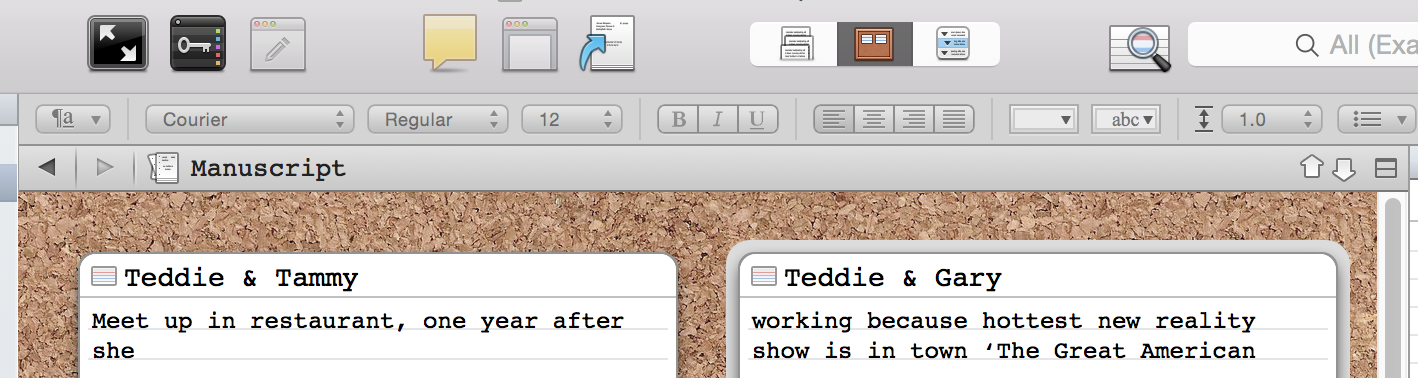
This is a huge benefit if you’re a plotter like me. I have all my scenes planned out, then I can put them together in cork board view. Like a real cork board, I can see the overall picture in one place, and move around anything I need.

Cork board

So here, for example, I’m not sure opening with the restaurant scene is dynamic enough. Each index card is tied to the scene itself, so if it’s not in the right place once it’s written, I can just move the index card and the scene within the manuscript will automatically move with it. Genius.

Name generator

This is a key feature that sets Scrivener above most word processing apps. When a book appears, the main characters usually bring with them a name. They’re not the ones you have to worry about. It’s when the secretary pops his head around the door to deliver some information and the protagonist says ‘Thank you -‘ and you don’t have that one-off name. Instead of agonising, or inserting ‘Secretary’s name here’, you can just pop up the word generator, set as much or as little background info as you like, and away you go!

Name generator


I think Hamish is a great name for a secretary…


Putting it all into Scrivener makes it real. It also removes any friction, so I don’t get distracted from the actual process. Once the detail has been loaded, it’s just down to the best and most exciting part of all.

Writing.

You can purchase, or find out more about Scrivener here.

To find out why they are meeting in the restaurant in that first (or maybe later!) scene, read The Crochet Killer on kindle, or Kobo.

Crochet Killer Cover

(also available on Nook and through the iBooks store)

Using Smashwords to promote across ebook platforms

For my first full length self-published eBook, The Crochet Killer, I started with what I knew: Kindle.

Amazon and KDP make it quite simple for authors to get their work out there. As a toe in the water it is a good place to start. But quite clearly, it is not the only place to market your eBook. There are many, many options.

All ever so slightly different.

smashwords

Getting your work out there is the priority for most writers, but the reality is that it’s the writing part they enjoy. Not the formatting. Not the setting up the Table of Contents at the front in a slightly different manner for each individual retailer. Or setting up the accounts on a multitude of sites.

Let’s be realistic here: most authors do not independently self-publish a book and then sit back as the royalties roll in. The dream of an overnight and massive success in publishing remains just that for most people: a dream.

This is only my first book. I am finding new readers and introducing myself to the world. My platform is in its infancy. A simple time / cost equation made my mind up about using Smashwords to instantly make all these options available to me:

smashwordsall

I took the hourly rate I charge for the day job. I then calculated the time it takes me to format each version of the book, set up the account, create the bio, sort out the accounting details (including additional time to make sure you meet with the tax requirements of the retailer’s home country etc) and see what it comes to. For book one, it wasn’t worth it when I can upload it to Smashwords and then they push it out for me.

In the future, depending on sales, I might do it on a site by site basis. But until then, this is the most easy and cost-effective option I can see of getting my books out there.

Available on Amazon.com (US)

Amazon.co.uk

Nook at Barnes and Noble

Kobo

And of course, Smashwords itself, along with now being available to download via the iBooks app, if that is your reader of choice.

Crochet Killer Cover

Why I wanted to write a lesbian detective

In my latest book, The Crochet Killer, the main character is a lesbian detective named Teddie McKay. I wanted to write this character for several reasons, and not just because all the lady police officers I know also like the ladies. I’m sure that’s just coincidence. Also, if you’re reading this, she’s totally not based on you. Honest.

Firstly, and most importantly, she came to me that way. There was never any doubt from the moment I pictured the opening chapter, with her diving into the pool on vacation in the Caribbean, that she was gay. It was just who she was, and that wasn’t a problem. It also wasn’t going to be a big deal.

In life, it shouldn’t be a big deal. So why should it be the one and only personality point of my character?

For most of the story, who she sleeps with is not a primary focus anyway. There is romance, but it is not the main theme or driver to the narrative. That would be the killing bits, obviously.

Other than times when a protagonist’s sexuality is front and centre to the narrative, it seemed to me like writers tended to default to straight. That’s not necessarily a problem, but a character being gay doesn’t have to make a point. The Crochet Killer isn’t a gruesome, terrifying thriller, designed to make you puke your guts up and unable to sleep at night. It’s for the kind of people who enjoy watching Castle, whilst having a secret hankering for seeing Beckett make out with a girl (again, if you’re reading this, you know who you are).

I suppose, what I am trying to say is that I wanted to write a lesbian detective because I wanted a regular, slightly mal-adjusted main character who just also happens to be gay. Will it narrow my audience? Probably. And if it does, then I’m okay with that. Because I would rather keep the character with the integrity she came with and the story she has to tell (and will continue to tell over the course of the series) than sell out by aiming for the safety of the middle ground.

That’s where everyone else is. I’d rather give a detective who isn’t white, straight and male a chance for once.

(Even though it’s set in Portland, Maine, for any British Kindle readers, you can find the UK edition here.)

Doing The Genre Swap

For all you writers out there, I have a question: do you write in multiple genres?

I was having a discussion with an author friend the other day and it occurred to me that it is becoming increasingly more common. In many other areas of our lives, we have come to expect the freedom to choose. For most of us, especially those of us who have tried our hand at self-publishing, it is more than just failing to be picked up by traditional publishers. I know many people believe that to be the case about what we do. I think that is making too simplistic an argument.

‘Traditional’ authors have started to dabble in the world of self-publishing because it gives them the taste of freedom that they can’t get as part of their three book deal. The one that states you will provide us with three books that sit comfortably in the brand that has been created for you. Please do not waste our investment in you by being adventurous. More of the same please. None of that creativity rubbish.

Which is where the theme of genre swap comes in. I write in several genres, and keeping up a pseudonym for all of them is like plate spinning. If you believe everything you read, then there needs to be a distinct platform for each genre, leading to twenty seven different twitter accounts.

No thanks.

I like to think that the reading audience is becoming more savvy. Or perhaps they have always been savvy, but traditional publishers have never seen the need to present them as such. Like writers, readers are more than happy to have a little variety. Sure, most people have a favourite genre, one they would go to first. But very few people I know would declare that they ‘only’ read crime these days. Or romance. People want to have a choice. A good story is a good story and more importantly, they want a character they can relate to.

Of course, when you have these multiple projects on the go, it can be hard to change between tone sometimes. The best way I’ve found is to create a distinct playlist for each book. For example, when I was writing The Crochet Killer I had a playlist with Crush by Jennifer Paige on it. Completely out of keeping with the crime tone of the book, but it always instantly reminded me of the main character when I needed to get back into her head. For another series I’m working on which is squarely Urban Fantasy, there’s a bit of Lady Gaga: Bad Romance sums up the darker side of the relationship between the two main characters perfectly.

So I’m not saying it’s easy, but it’s certainly possible and becoming more common. If you want to write in multiple genres, then go ahead.

And if you have any tips and tricks for swapping between the two (or more) then let me know!

****

Crochet Killer Cover

He likes to make women smile.
For eternity.

From her hot Caribbean vacation to a freak New England snowstorm, when the fourth mutilated victim is found, Detective Teddie McKay knows she has to break the case or lose it. The killer is always one step ahead, and even the hot-shot forensic investigator the Chief has shipped in from out of state hasn’t produced a solid lead. The pressure is coming from everywhere; the press and even the Mayor are questioning whether Teddie’s up to the task. Now her ex-lover, TV reporter Tammy Johnson, has re-entered her life and is covering the story. Teddie knows that if someone makes the connection it will be the final nail in the coffin for her credibility.

As the clock ticks down towards victim number five, Teddie knows she has to do something to solve the case. But how much is she prepared to risk to lure a psychopath out into the open?

New Novel: The Crochet Killer

I’m delighted to be able to introduce my new novel, The Crochet Killer, which has been released today.

Crochet Killer Cover

The Crochet Killer at Amazon.co.uk

The Crochet Killer at Amazon.com

I’ve had a lot of fun writing this, even if it is a book with some dark moments. I absolutely love the characters and have had a great time making them do what I wanted them to do (and sometimes vice versa).

This is the first book in the series which introduces Detective Teddie McKay, getting ahead in Robbery-Homicide in a city that has infinitely more of the former than the latter. In over her head, with a serial killer on the loose, she has no choice but to rely on other people instead of her gut instinct. Nicknamed The Crochet Killer by the media, the man certainly has a gift for needlework. It’s just a shame that his canvases of choice are the faces of the women he hunts and kills.

Of course, as the body count rises, people are bound to question if she is up to the task. In her darkest moments alone, beer in hand, she’s having doubts herself. The Chief is under pressure and he’s more than happy to pass some of that along. He’s even made sure that one of the best forensic investigators in the country, Kathryn Greene, joins the team to make sure they’re not missing anything.

There is no escape from her lack of success. The case is on rolling rotation on the TV news, where the face of her ex-girlfriend Tammy Johnson is a constant reminder of the other failures in her life too. When Tammy reappears in her life, Teddie finds it hard to believe that she’s not there just for the story. Is she willing to risk letting her back in if it means she will lose this case for good if anyone finds out?

And what else is she prepared to risk to finally bring The Crochet Killer to justice?

Crochet Killer Cover


Line Edits Are Done

I can feel the tingle of fear beginning to build as the line edits are now completed on my first ‘to be published’ novel. This means the last few little bits need to be tweaked, the marketing and promo content pulled together into a cohesive package and then it will be good to go.

My next post will probably detail more about the book itself, but for now let me say that the characters have been fun ones to write. The biggest issue so far between the people I’ve sent it to has been the name of the main character. At this point, it is still subject to change. Which is kind of awkward.

It is actually really easy to self-publish something these days. There are no barriers to entry as long as you have a computer, a little bit of technological savvy and a bank account for your hard earned royalties. There are posts scattered all over the internet reiterating this. The freedom is both a blessing and a curse. If you want to put up something you are proud of, then it actually takes a lot of hard work and you have to treat it as though you are all the parts of the traditional publishing process. This takes time. Commitment. Help from others where possible. And while you are doing that, more and more books continue to flood the market, making it harder to stand out.

So for this one, I have some aspirations, a few goals I would like to hit. Nothing more than that. No delusions that despite the hard work this is going to be a best seller or a masterpiece of literature. It’s not meant to be. It is a fun crime drama with an appeal to a certain market. If they like it, then that’s good enough. As long as one other person gets as much pleasure out of it as I did, then each one of those pesky line edits will have been worth it.

Understanding Your Inner Writer

This is a sabbatical post while I am away on my mini writing retreat

As I am currently focussing inward, I thought I would draw your attention to this post on how we can get closer to our true selves. I know that I usually stick to the topic of writing rather than over-arching personal development stuff, but given that I feel this is part of informing who we are, and therefore what and how we write, I thought it was appropriate.

I travel a lot. There is something unsettling, on some level, about so much time on the road. It stops you from getting comfortable and complacent. It is hard to be motivated and inspired to write every day when your life is routine and comfortable. Perhaps that is why so many great books come from people who were going through a bad spell? As much as the experience itself informs what they write, that sense of urgency which comes from not knowing what life will be one day to the next is a powerful tool. It is there to all of us, to some degree, if we choose to use it. Travel doesn’t automatically have to be to some far flung part of the globe (although that is always nice). It can be a bus ticket to somewhere, anywhere, that you haven’t been before and looking at this new place with new eyes.

The easiest one, I suppose, is embracing time alone. Most writers work in a solitary fashion, but more often than not, we do so whilst surfing the net claiming to be writing. Yes, you know what I’m talking about. I’m not talking about that time alone. I’m talking about the truly quiet time, when we think about not only writing itself, but where it fits in our lives. Is it a hobby, something secret that you want to keep just for yourself? Or do you have dreams of being published some day? Would you like to be traditionally published, or self-published? Take the time to truly visualise your dream.

I suspect that although I have scheduled this post, that is what I will be doing right now. I don’t feel guilty or selfish about it. I do it because it needs to be done, because it will not only make me a better writer, but also a better person.

And who doesn’t want that for themselves, really?

LGBT Main Character In Urban Fantasy – Too Niche For You?

I am working through some final edits of my (hopefully) soon to be published book and am currently receiving conflicting views from my beta readers, so I am asking for help.

My novel has a female protagonist, but the very important second character is also female. Most urban fantasy stories I read have an element of romance running through them even if they are not dark romances as such. This inevitably seems to be heterosexual (if it isn’t heterosexual then it seems to be emphasised as lgbt automatically, even if that element is incidental). During the first and second drafts, my female leads developed an intense sexual chemistry which I have been previously attempting to edit out so it is not off-putting to straight readers. Particularly straight female readers, I suppose.

Unfortunately, I think that as this series develops, by doing this I am going to be cutting out a strong element of the story, so am reluctant to do so. Of course, that could mean they ultimately end up together further down the line.

Would this turn off the average urban fantasy reader? Any hot girl on girl action would be (for now at least) incidental to the plot and purely character development.

I’d love it if you could fill in the survey below to give me an idea of which way to swing on this (every pun intended). If you don’t have time for that, a quick note in the comments section below would be awesome.

Survey Me – I have opinions!!

Thank you to everyone who takes part!

Things Not To Love: Marketing

For some authors, self-promotion seems to be their strength. If they have any doubts about the quality of their work, then they sure as hell don’t show it. You’d think they’d written the book for all time in the way they talk about their middle of the road thriller. If I sound jealous, it’s because I am. Not because I want to write middle of the road anything, but because I want to be able to have that level of confidence and self-assuredness about a product that has gone through the quality control I have chosen for it, not the route that industry experience diehards would have picked instead. But for that to be the case, I’d have to be a different person. Probably American.

I recently read an article called How to Reach More Readers by Harnessing Retailers’ Algorithms by Simon Denman. I think the opening that caught my eye was the line Most authors I know enjoy marketing about as much as filing tax returns, and my first thought was ‘that much?’. But the article itself posed some interesting theories about how marketing and promotion now work in an internet based age. Bookstores don’t really have algorithms. For a good long time they’ve had experienced professionals who would be able to guess how many copies would shift based on their local demographic and retail location, but I strongly suspect that is now a growing art.

Algorithm

It leaves me to question then, how many of the best selling self published authors are doing this kind of thing? I know that with my daily life, I’m not sure I have time to work out algorithm selling strategies, even if I was at that point in the journey. It’s no secret that I’m just starting out on this road, with a couple of books queued up but still in the final stages of edit and cover design. Whilst I look forward very much to the satisfaction of getting them out there, the prospect of marketing is bad enough without having to factor in scheduling a three day continuous upswing in sales to trigger some piece of maths somewhere in the amazon superbrain.

So is it luck or strategy? And does anyone know of a guaranteed way to do it without requiring some kind of advanced calculus…?