Tag Archives: writing tools

Being a writing road warrior

It’s no secret that I spend a lot of time on the road. I also spend a lot of time writing. There is a real art to balancing the two and so I thought it would be a good time to do a short post on how to make this as easy as possible. Because that is what life is about really. Getting as much as possible with the smallest amount of effort.

I am a serious fan of quick wins. I accidentally typed quick wines, which I guess also applies, but I’ll save those for another post.

This itself will be short and sweet and divided into two sections: principles and tools.

There are a couple of principles that I always keep in mind when I am on the road. Most of these are based on a GTD style system. I’ve found that this is the best way to make sure that I can continue to make progress even in the toughest of circumstances.

Firstly, it helps to always know exactly what you have to do. It doesn’t matter if you capture this in a list, or a calendar, or an app that can add all the whistles and bells that make you feel good. The only definite element is that it needs to be stored somewhere other than your head. The key is to knowing, in that moment when you have thirty minutes to spare, exactly what it is that you need to do. No additional thinking required that causes you to instantly lose ten of those thirty minutes before you even begin.

Secondly, when you have those creative thoughts, you have to have somewhere to capture them. Mark my words, the biggest and best ideas will always come at the most inopportune moments. That is just the way the universe works. Again, it doesn’t matter what you use to do it.  You just have to make sure that you’re not trying to remember it over and over again until you get back to your computer and start working on it.

Thirdly, make sure your travelling setup resembles your static setup as best as possible. I do this by making sure I have devices that all sync and everything goes via dropbox. When I sit down to work in a hotel room, I want to make sure I can remove the friction as much as possible. It needs to feel natural, not a pain to even get going.

Lastly, try to stick to your routines as much as possible too. If you have a morning routine, like I do, try not to let it all go to hell just because you’re not sleeping in your own bed. If exercise is part of your routine before you write, then remember to pack your gym clothes and try to pick your hotel around its facilities. It all sounds a bit serious, but the payoff in terms of quality time getting the words down is enormous.

That’s it for the principles, so let’s move onto tools. Whilst I think the tips above can apply to everyone (and not just to writing, but to anything else that you try to maintain on the road), tools are particularly subjective. I’ll just tell you what works for me and hope that it gives you some ideas.

For tracking what I need to do with my writing, I use an app called Nozbe. This allows me to break down what I need to do into categories, projects, contexts etc, so I can instantly know what task best fits my current surroundings and time available.

For capturing ideas, to me there is nothing better than a notebook and pen. I keep a small pocket notebook with me and a fisher space pen, because that means I can write on a plane without the fear of an ink explosion rendering my journey utterly miserable. It’s nice and compact too, so it can just get shoved in my pocket if I need to be truly mobile.

It’s a shame Scrivener doesn’t make a mobile app, otherwise I could use it on my iPad in the same way I use it on my macbook. For everything else, I use an iPad with a bluetooth keyboard to remain as portable and functional as possible. As soon as there is a Scrivener iPad app, I’ll probably even buy a new iPad to go with it. Yes, I love Scrivener that much.

I know that I could probably have a multitude of other things. It’s not about being perfect, it’s about having what you need in as few items as possible. After all, you don’t want to be weighed down while travelling as that will impact on the areas outside the sphere of writing.

Of course, there is one other ‘must have’ item that I’ve failed to mention so far. On the road or curled up at home, a writer just has to have coffee…
 

Do the KDP structure changes make Amazon the enemy?

I have seen much outrage (and confusion) since Amazon announced it was to make changes to the payment structure for books. In case you haven’t heard about it, the Publishers Weekly article goes into detail about it here.

A lot of the criticism seems to come from an initial bout of ‘you’ll only get paid if someone finishes the book’. In fact the statement is as follows:

Under this new model, the amount an author earns will be determined by their share of total pages read rather than their share of total qualified borrows.

At the moment, this also only applies to books that are in the kdp select programme, which pays out a percentage based on those borrows as part of Kindle Unlimited or the Kindle Owners Lending Library. I’m processing how I feel about this, but two obvious things spring to mind.

Firstly, this is potentially the tip of the iceberg that becomes the standard model for all books, irrespective of whether they were purchased outright rather than borrowed. While I know most people who aren’t in the game will assume that this kind of change will only have any real impact on self-published authors, I know there are a lot of books out there that have hit the best seller charts and yet nobody ever actually gets round to finishing or reading.

Secondly, how much data is Amazon actually collecting on people? Number of page reads and the amount of time spent on each one in order for it to actually qualify as being ‘read’ seems like getting down to a level of granularity that is quite off-putting. No lingering or re-reading that favourite sex scene over and over. Big brother is watching you (and now really knows what you like).

As with all change, there are pros and cons. I can see the value of someone who has produced a good, 200 page book being paid more than someone who has churned out a 20 page quickie. However, that does set a dangerous assumption that quality is the same as length, which we all know isn’t true. Get your mind out of the gutter, I’m still talking about books here.

The reality is that Amazon can do largely what it wants, as it is by far the largest retailer of ebooks. Nothing else really comes close. However, that is reliant on people using the kindle as the ereader of choice, and on authors being willing to upload their words. Being the market dominator can change quickly when your customers decide to take a look at those alternatives after all.

Just ask Blackberry.

Writing and motivation: keeping the momentum going

I find the long weekend has been perfect for a little bit of extra introspection time.

I’ve spent the past few months building up to publishing Blood Inheritance, with the crazy planning and scheduling that goes with such a big endeavour. I say that because we should not belittle our achievements. I am terrible at taking time out to celebrate when I hit my goals. I’ve been talking about getting this book out there for the best part of two years, so I’m allowed to high five myself for being brave and letting one of my babies fly the nest.

The downside in achieving something that has taken up so much of your time and attention for months is that after the excitement fades, then there is a moment when you realise the enormity of the void it has left behind. Instead of breathing a sigh of relief that you have now got so many hours of your life back each week, you sense the loss. There is only one thing to do.

You have to keep going.

There will always be another book brewing on the horizon. There will always be an idea to be captured and the seed of the idea planted so it can grow. Writing tasks will never disappear completely, but neither will the joy of those first moments of creation. So when the sigh of relief wears off and I begin to think about that sudden free time, it’s always good to know that I have several projects I can dip into.

It is good to take a break. It is good to allow yourself to recharge. It is not good to allow that to turn into sloppiness and complacency. So how do you avoid it? It’s quite simple really.

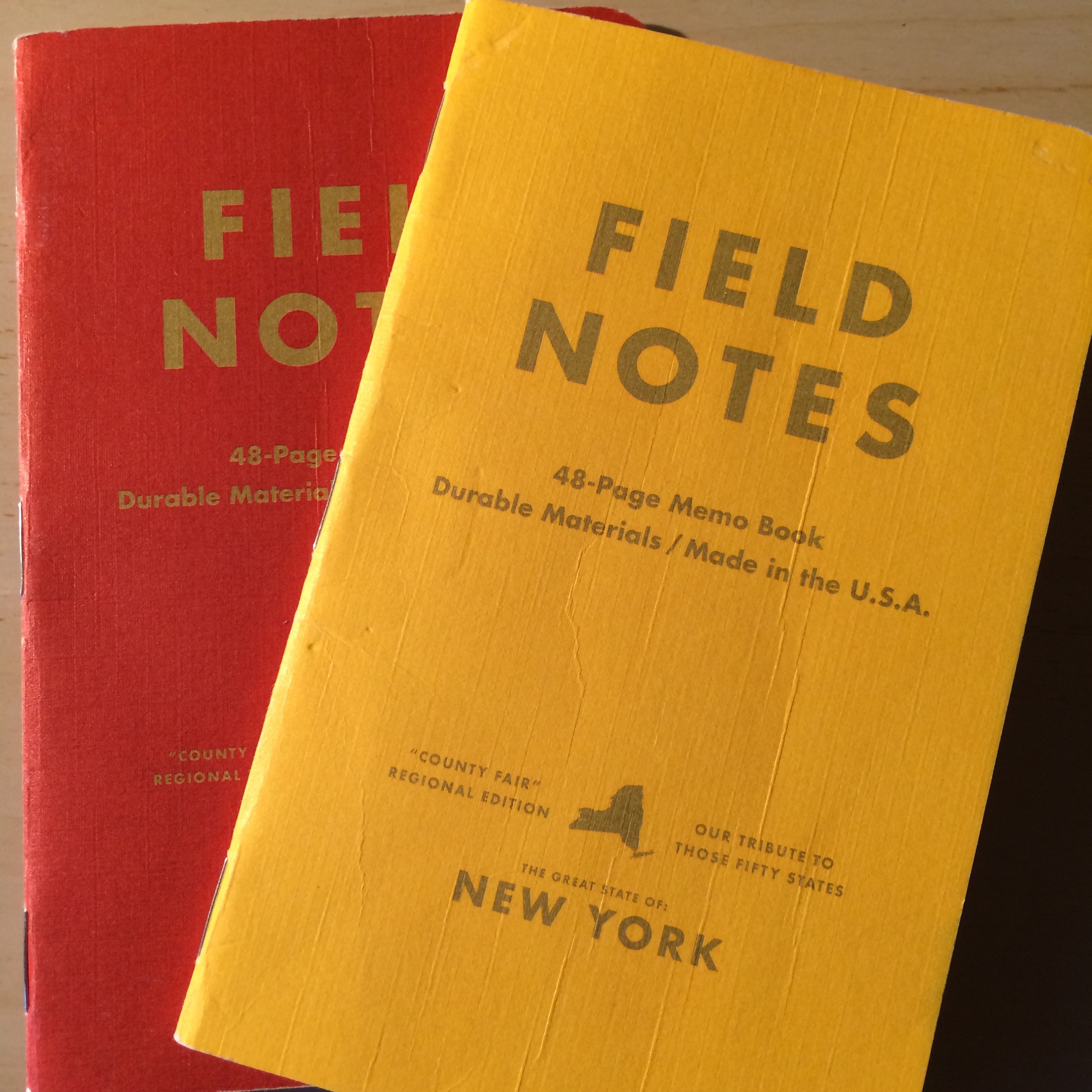
fieldnotes1. Keep a notebook. Capture your ideas somewhere safe so you don’t have to keep them in your head. Then they’ll always be there waiting for you when you need them.

2. Plan your next project before you finish your current one. In those quiet times, those moments when you find yourself twiddling your thumbs, think about what you want your next project to be and outline what next actions you’ll be taking on it. That removes the panic of having to come up with something spur of the moment.

3. Be realistic with your scheduling. Each project will be different, but each one will also take a lot of hard work. Be kind to yourself and allow yourself adequate time when planning your project. Don’t be too generous though. You want to have enough tension there to motivate you to do something, rather than having the psychological freedom to continually defer it until next week. Be sensible, but also give yourself a deadline. Even self-imposed ones carry a punch when you keep a reminder of them where you can see them.

So that’s what I’ll be doing. The first draft of the next Teddie McKay novel is nearly complete and I’m going to be working through that for the next few months. My goal is to publish it in September, so that is the deadline keeping me on track. Whilst Blood Inheritance may be published, everyone knows that is not the point at which marketing and reader engagement stops. Of course, I’ve already got the next book I’m editing decided and set up to make it easy to start.

So the void of time was relatively short; I’m back to writing again.

C. S. Lewis – Was it the thumb or the rhythm?

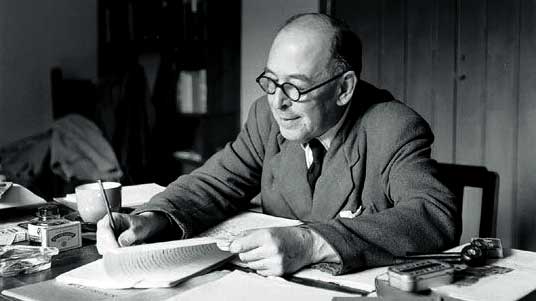
C.S Lewis wrote under the pseudonym Clive Hamilton when it came to his poems, something he wished to achieve greatness in. His death was largely unreported because it unfortunately happened on the same day as JFK was assassinated. Oh, and he only had one thumb joint.

I mention that last point because C. S. Lewis never learned to type. That was what I discovered when I was looking at the arguments for and against writing longhand in the age of technology. Some have pointed at the weird thumb goings on as the cause, but it may not be anything as physiological. Instead there is the suggestion it is something much deeper. Something that all of us, as writers, should consider.

cs lewis writing

He apparently believed that the typewriter could not capture – perhaps even interrupted – the rhythm of writing. There have been many authors since who have followed the same argument; that there is something much more deliberate about writing with a pen and paper than there is on a keyboard. Today especially, when keys are whisper soft and require only the barest of touches, it is easy to pour out the words lightening quick. You don’t even have to press hard or do that thing at the end of the line when the carriage returns with a happy little ‘ding’ sound. Apologies to any younger readers who legitimately have no idea what I’m talking about. You should try and find a good old fashioned typewriter some time.

The pen forces a slowness, a deliberateness; each word can be thought about and selected as the hand forms its predecessor. For many authors today, especially those who are self-published and feel the pressure to release multiple books a year, there is a sense that every word must be captured as quickly as possible, in a format that will then make the movements from first draft to epub as smooth as possible. I would argue that in doing so, we lose not only some of the pleasure of writing, but some of the ability to fully utilise our skills as writers. We have a wealth of words at our disposal, and typing quickly might allow us to use a good one, but it might not allow us the time to choose the best one.


Another hotel room, another night of writing on the road

You’d think I’d be used to writing in hotel rooms by now. Sadly, I’ve discovered that most hotel rooms are the exact opposite of conducive to decent writing time. It’s driving me nuts!

There are many advantages to writing in this golden age of the internet. It doesn’t matter that I’m sitting here at a strange desk, not when I can google any pieces of information I don’t have immediately to hand. I can’t imagine what it must have been like for those using a typewriter, reaching for a thesaurus and only finding a Gideons bible and some hotel headed notepaper.

Maybe a room service menu, if you were staying somewhere classy…

Several of the greatest authors of all time produced career-defining works whilst living in hotel rooms. But let’s face it, none of them were probably staying at a Holiday Inn…

If you want to get things done, you have to force yourself to do them. I’ve realised over the past year that I actually do my best work when surrounded by creature comforts: my inspirational artwork on the walls, the sofa in the office, the books lining the walls. A stack of pens and notepads within arm’s reach to jot ideas. This is the perfect place for me to write.

It’s also the place I’m not in nearly as much as I would like.

I’m now beginning a quest instead to beat this frustration. Instead of just getting annoyed by the reduced output, I’m going to find a way to make the most of the time on the road, no matter how luxurious or shoddy the hotel is. I’m going to become a writing road warrior.

For now my only piece of advice, to quote Ben Folds, is ‘do it anyway’. Which, although it is probably the singular most important thing, is trite and meaningless without working out how. I love a good mystery, so I’m going to get to the bottom of it. Tonight, I’m going to revise this terrible scene that is refusing to co-operate, regardless of where I am sitting when I look at it. Maybe fixing that will help me unlock the keys to making the whole thing work.

Wish me luck!

Do you plan your writing, or do you just wing it?

One of my key strategies to write books whilst holding down a 40+ hour a week bill-paying job, travel, and juggling family commitments, is to make sure my writing is planned in advance to sitting down in front of the laptop first thing in the morning.

I know that I don’t come up with ideas at that time in the morning, especially when I’m on the road. Likewise, for a lot of people who are more creative in the evenings, much of the ability to focus on the detail has already been drained out of our brains by the time we get that alone time to begin our writing.

Yet the debate still rages about whether or not to plan your book in advance of writing it, or to allow it to be a truly creative endeavour, flowing from your brain as the muses come to you, without one iota of reference material to refer to.

I suspect, for those who are adamantly non-planners, there is still a degree of preparation that takes place. Even if it is the development of a character profile, or a key theme you want to put across. Perhaps you already know that one crucial plot point that you want to include that you know will provide a massive payoff in drama and tension. You may not have done a scene by scene account, but there is something you’ve already committed to making happen.

I’ve also heard it said that people gravitate more towards planning when they stop writing for fun, or as a hobby, and move to writing that has deadlines. I can believe that. Sitting around and waiting to be inspired just isn’t going to cut it when your publisher is demanding you return that advance. For self-publishing authors, once you’ve committed to doing it, the deadlines are self-imposed, but they are just as real.

I’m moving through this journey of being an Indie author, with side plans to take the novel part of my writing down the traditional publishing route also. When I find things I believe are useful and can help other people, I want to be able to share them here. But a lot of those things will involve planning and discovery. I’m intrigued to know if those are likely to be of interest to you, or if you’d be more interested in reading about more spontaneous approaches to creativity.

So are you a planner or a do you like to fly by the seat of your pants? Take my short survey (just 4 easy questions I promise) and let me know. Alternatively, feel free to drop me your thoughts in the comments!

Setting up a new project in Scrivener

Now my first full length novel has been out for a month, it is time to turn my attention to writing the sequel. I’m a plotter and a planner, which is why I absolutely adore Scrivener. I can hand on heart say it is the best software investment I have ever made.

Here’s why. I can control everything I need, all in one place.

My characters

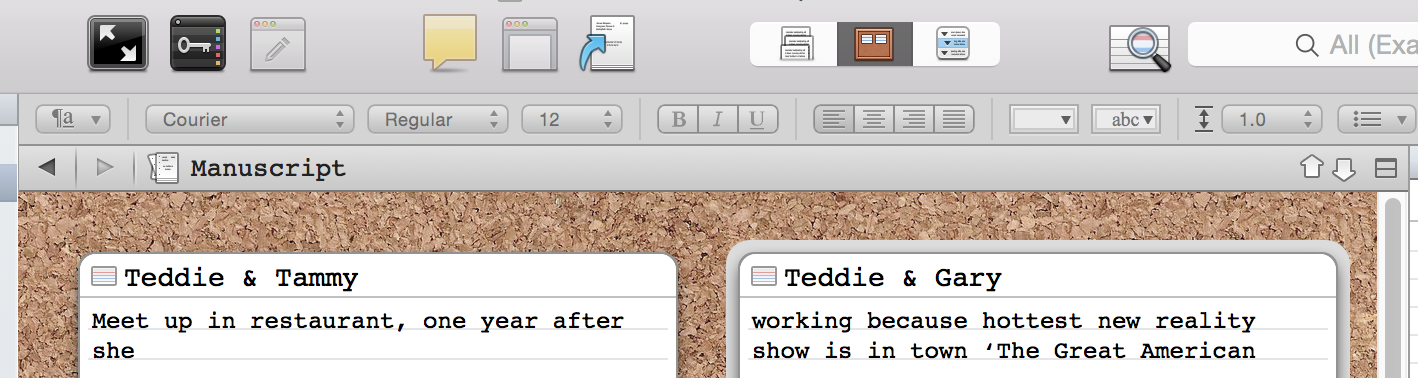
I love the character template feature. As Teddie McKay is back again for a second instalment, I can just copy the template from The Crochet Killer straight into the new setup and we’re good to go:

Characters


I can just update them with any new information, such as internal or external conflicts, character development and move on, knowing that the information will be there for me if I need to reference it. No scrabbling through notebooks to see if that tattoo was of a dolphin or a unicorn.

The cork board

This is a huge benefit if you’re a plotter like me. I have all my scenes planned out, then I can put them together in cork board view. Like a real cork board, I can see the overall picture in one place, and move around anything I need.

Cork board

So here, for example, I’m not sure opening with the restaurant scene is dynamic enough. Each index card is tied to the scene itself, so if it’s not in the right place once it’s written, I can just move the index card and the scene within the manuscript will automatically move with it. Genius.

Name generator

This is a key feature that sets Scrivener above most word processing apps. When a book appears, the main characters usually bring with them a name. They’re not the ones you have to worry about. It’s when the secretary pops his head around the door to deliver some information and the protagonist says ‘Thank you -‘ and you don’t have that one-off name. Instead of agonising, or inserting ‘Secretary’s name here’, you can just pop up the word generator, set as much or as little background info as you like, and away you go!

Name generator


I think Hamish is a great name for a secretary…


Putting it all into Scrivener makes it real. It also removes any friction, so I don’t get distracted from the actual process. Once the detail has been loaded, it’s just down to the best and most exciting part of all.

Writing.

You can purchase, or find out more about Scrivener here.

To find out why they are meeting in the restaurant in that first (or maybe later!) scene, read The Crochet Killer on kindle, or Kobo.

Crochet Killer Cover

(also available on Nook and through the iBooks store)

Using Smashwords to promote across ebook platforms

For my first full length self-published eBook, The Crochet Killer, I started with what I knew: Kindle.

Amazon and KDP make it quite simple for authors to get their work out there. As a toe in the water it is a good place to start. But quite clearly, it is not the only place to market your eBook. There are many, many options.

All ever so slightly different.

smashwords

Getting your work out there is the priority for most writers, but the reality is that it’s the writing part they enjoy. Not the formatting. Not the setting up the Table of Contents at the front in a slightly different manner for each individual retailer. Or setting up the accounts on a multitude of sites.

Let’s be realistic here: most authors do not independently self-publish a book and then sit back as the royalties roll in. The dream of an overnight and massive success in publishing remains just that for most people: a dream.

This is only my first book. I am finding new readers and introducing myself to the world. My platform is in its infancy. A simple time / cost equation made my mind up about using Smashwords to instantly make all these options available to me:

smashwordsall

I took the hourly rate I charge for the day job. I then calculated the time it takes me to format each version of the book, set up the account, create the bio, sort out the accounting details (including additional time to make sure you meet with the tax requirements of the retailer’s home country etc) and see what it comes to. For book one, it wasn’t worth it when I can upload it to Smashwords and then they push it out for me.

In the future, depending on sales, I might do it on a site by site basis. But until then, this is the most easy and cost-effective option I can see of getting my books out there.

Available on Amazon.com (US)

Amazon.co.uk

Nook at Barnes and Noble

Kobo

And of course, Smashwords itself, along with now being available to download via the iBooks app, if that is your reader of choice.

Crochet Killer Cover

Random Title Generator

I love a good random title generator. Actually, I love a bad random title generator. The ones which come up with the most cheesy and clichéd titles. You know the ones, they come with a narrator in your head that sounds a bit like you’re listening to someone from Downton Abbey.

The Professional Dreamer

The Memory of the Beginning

The Moon’s Willow

Apologies if those are anyone’s actual titles. But I’ve actually discovered something quite useful as part of this humour. For some reason, by scrolling through those randomly generated nonsense titles, it can actually trigger something at the back of your brain which is infinitely more creative.

You don’t have to be just seeking a title in order for this to work. I have found that when I have reached a tricky plot point, where I’ve painted myself into a corner and realised that despite my best laid plans, the whole thing has got stuck, that using this tool can actually help. The randomness of it is the key, I think, in that it forces your brain to start looking for patterns that you might not spot elsewhere.

I’ve tried this a few times now and find that it works pretty well. Even when it doesn’t fully get me to undo the problem, it still gives me a firm shove in the right direction. Leaving my subconscious to work on it for a few more days afterwards generally does the trick.

So next time you find yourself floundering, give it a go. And if nothing else, some of them are so bad it will give you a genuine belly laugh that will help you to forget the problem altogether for a while.

Why I’m planning to eat healthier this month

January is always the month that gets the best of people’s good intentions. In reality, my health has been on the back burner in January, for many reasons. Instead, February is the month that is going to get the most of my intentions when it comes to health. Why? Because my writing has both benefited and suffered from the lack of good diet during January.

Not worrying about food has helped me get The Crochet Killer published and over the line. Getting all the input I needed, putting the last pieces together, that requires a lot of time and chasing. Time that can be made up from easy food choices of the kind that require zero thought.

Unfortunately, that is only a short term solution. I have had the time and the motivation for that quick burst, but now I enter the first Monday of February feeling sluggish and displaced. I can feel the weight of a thousand chips settling somewhere just below my belly button.

And above it, if we’re being entirely honest.

Food is important. Life is important. The only way to achieve as much as possible (I initially wrote ‘achieve it all’ but have come to realise that is a modern myth), is by being as holistic as the tools you have available allow you to be.

My writing and travel schedules in February are going to be punishing. Which is why I would encourage everyone who is out there in the same position – with a full life and plenty of challenges – to still dedicate time to getting their health and wellbeing in place.

Because writing is nothing if you’re either too tired or dead to do anything with it.